


CORPUSCULE DANSE
INCLUSIVE CONTEMPORARY DANCE


Founded in 2000, Corpuscule Danse is dedicated to developing and promoting inclusive dance based on the encounter between dancers with and without visible or invisible disabilities.
NEWS
SHOWS AVAILABLE


L'AFFRONT DES CHIMÈRES

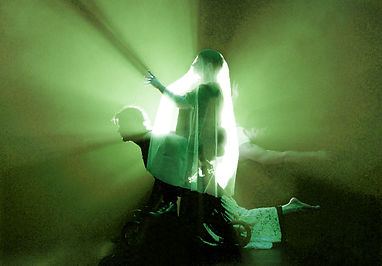
SUMMARY - L'AFFRONT DES CHIMÈRES
Creation 2026 / Length: 55 min / 4 Dancers
Audiences: 13 +
Wordless (except for a few passages in French)
L'affront des chimères is the latest creation by Corpuscule Danse. Designed for teenagers, this piece takes the form of a Hitchcock-style thriller and explores anxiety through a fable about confronting our fears.
There is a great deal of mystery in the Other, especially when the Other falls outside the norm. By using suspense, we seek to welcome this element of mystery that can sometimes frighten us, convinced that when fear steps out of the shadows and into the light, it suddenly appears less terrifying.
Drawing on a culture of competition and pressures related to body image, we focus in particular on performance anxiety, marked by the fear of displeasing, of not measuring up, of failing to meet expectations, of not being “ideal.”
But who creates this unattainable ideal? What becomes of it when one lives with a functional diversity that systematically marginalizes them? What if this ideal—like Frankenstein’s creature, assembled piece by piece—were the true threat, the real monster to be confronted?
WHEN YOU LOOK AT ME | 6-12


SUMMARY - QUAND TU ME REGARDES
Creation 2017 / 50min / 3 Dancers
Audiences: 6 à 12 ans + All ages
Wordless (except for a few passages in French)
Quand tu me regardes is the first piece by the Corpuscule Danse company dedicated to a young audience, and is an encounter between dance and object theater. It is aimed at 6-12 year-olds, but is also open to all audiences.
Faithful to its mission, and backed by a long experience in integrated/inclusive dance, Corpuscule Danse here tackles the notion of belonging to the body and its extensions, which are often essential to mobility when you're disabled.
Through playful and visual elements, between construction and deconstruction, the piece proposes a reflection on difference and the way we look at it. Our three acolytes navigate a playful and poetic space alongside wheelchairs, which in turn take on a life of their own, transforming themselves into entities.